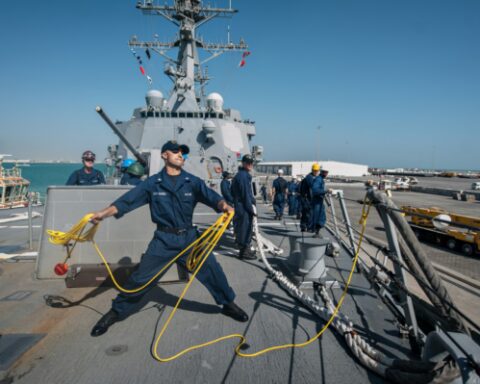

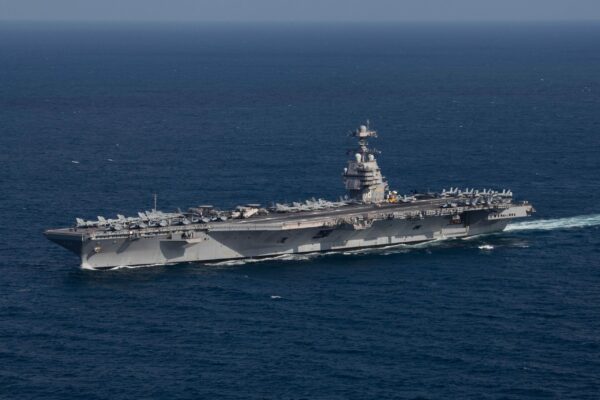
President Donald Trump revealed that the United States has already dispatched a powerful naval armada to the region and is weighing whether to send even more firepower as tensions with Iran continue to unfold.
“We have an armada that is heading there, and another one might be going,” Trump said, clarifying that he is “thinking” about deploying an additional aircraft carrier to the area.
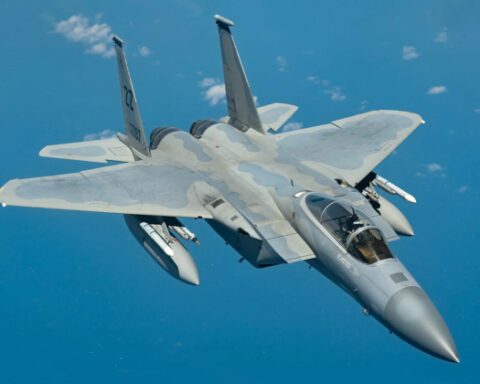
A U.S. official confirmed to Axios that discussions about a potential second deployment have taken place, signaling that the administration is actively considering expanding the American military presence. Currently, the USS Abraham Lincoln and its strike group are already operating in the region. The carrier group is equipped with fighter jets, Tomahawk missiles and several accompanying ships, underscoring the seriousness of the U.S. posture.
Despite the show of strength, the president expressed confidence that diplomacy may ultimately prevail. Trump told Axios that Iran “wants to make a deal very badly” and suggested that Tehran is engaging more seriously in negotiations because of the visible U.S. military buildup.
“Last time they didn’t believe I would do it,” Trump said, referencing June’s strikes on Iranian nuclear facilities. “They overplayed their hand.”
According to Trump, the current situation stands in sharp contrast to prior standoffs.
“This round,” he told Axios, “is very different.”
The president’s comments reflect a dual-track approach: maintaining a significant military presence while leaving the door open for negotiations. By signaling both readiness and restraint, Trump appears to be leveraging the U.S. buildup as a means of strengthening America’s hand at the bargaining table.
The possibility of deploying another carrier would further reinforce that message. An aircraft carrier strike group represents one of the most formidable tools in the U.S. military arsenal, capable of projecting air and missile power across vast distances. With the USS Abraham Lincoln already in position, the addition of another carrier would mark a notable escalation in presence, even as the administration continues to emphasize diplomacy.
Meanwhile, developments on the diplomatic front are also moving quickly. Axios reported that Israeli Prime Minister Benjamin Netanyahu is scheduled to travel to the White House next week. The visit will mark his seventh since Trump returned to office.
Netanyahu is expected to “present to the president [Israel’s] outlook regarding the principles of these negotiations,” according to Axios. The high-level meeting signals close coordination between Washington and Jerusalem as discussions over Iran’s nuclear program and broader regional dynamics continue.
Trump’s remarks suggest that he believes the combination of military readiness and diplomatic engagement is shifting the calculus in Tehran. By pointing to June’s strikes and asserting that Iran misjudged his willingness to act in the past, the president framed the current moment as one in which American resolve is being taken more seriously.
While the administration has not announced a final decision on sending a second carrier, the confirmation that such discussions are underway underscores the fluid nature of the situation. For now, the USS Abraham Lincoln strike group remains in the region as negotiations unfold, with the White House signaling both strength and openness to a deal.
As talks progress and key allies like Israel weigh in, Trump’s approach appears centered on maintaining leverage — projecting power while pressing for an agreement he says Iran now wants “very badly.”
[READ MORE: Trump Threatens to Halt U.S.-Canada Bridge Opening, Demands Fair Trade Talks]