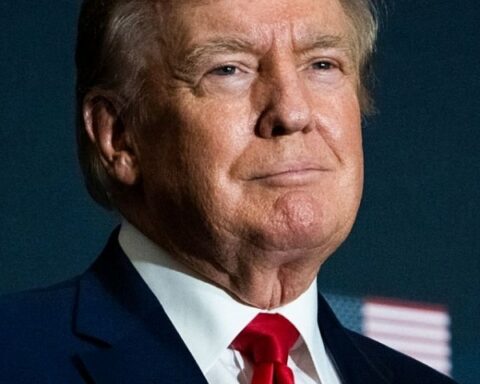


President Donald Trump declared Friday that he will accept nothing less than “unconditional surrender” from Iran, dramatically raising the stakes in the ongoing conflict and signaling that the confrontation could stretch on if Tehran refuses to comply.
The demand came in a social media post issued nearly a week after the United States and Israel launched a joint bombing campaign targeting Iranian military capabilities. While the strikes have inflicted significant damage, Iran has shown no public willingness to capitulate.
Instead, the Iranian regime has expanded its response, launching missiles and drones at Arab nations that host American military bases. Though those retaliatory attacks have reportedly decreased in scale in recent days, they have widened the conflict beyond Iran’s borders and heightened tensions across the region.
Trump’s latest comments suggest a broader vision for the end of the conflict. According to the president, Iran’s surrender would be followed by the selection of what he called “GREAT & ACCEPTABLE Leader(s)” to guide the country forward. He added that the United States and its allies would then work to help rebuild the nation.
“After that,” Trump wrote, the U.S. and its partners “will work tirelessly to bring Iran back from the brink of destruction.”
The statement represents the most sweeping goal the president has outlined since the conflict began, and it comes after several different explanations of the war’s objectives have circulated within the administration.
At the start of the American strikes, Trump suggested that the Iranian people should rise up and overthrow their government. In the days that followed, however, key administration officials shifted the focus away from regime change.
Secretary of State Marco Rubio and Defense Secretary Pete Hegseth emphasized that the primary mission was to eliminate Iran’s nuclear program and cripple its ability to launch missile attacks against Israel, neighboring Arab states, or potentially the United States itself.
Hegseth also made clear that the administration was not interested in repeating the kinds of prolonged nation-building efforts that characterized earlier conflicts in the Middle East. Speaking to reporters, he dismissed the idea that the United States would attempt to construct a new political system in Iran similar to efforts undertaken in Afghanistan and Iraq during the Bush administration.
Despite those statements, Trump has repeatedly returned to the idea that a change in leadership could follow the conflict.
In discussing potential outcomes, the president has cited the example of American action in Venezuela. In that case, U.S. forces removed Nicolás Maduro from power and allowed Vice President Delcy Rodríguez to assume leadership, provided she complied with American demands, particularly regarding access to oil resources.
Trump has suggested that a similar approach could work in Iran, despite major differences between the two countries. Iran’s population of roughly 92 million is nearly three times that of Venezuela, and its government is heavily influenced by clerical authorities and the Islamic Revolutionary Guards Corps.
In a brief telephone interview with CNN on Friday, Trump expressed confidence that such a transition could still succeed.
“It’s going to work very easily,” he said. “It’s going to work like in Venezuela.”
The president also said he would not necessarily insist on a Western-style democratic system in Iran. Instead, he indicated that he would be willing to work with moderate Shia religious leaders if they maintained fair relations with both the United States and Israel.
“I don’t mind religious leaders,” Trump said. “I deal with a lot of religious leaders.”
Looking beyond the current conflict, Trump added that he expects Cuba’s communist government could also fall in the near future — a development that, in his view, would represent a major geopolitical shift among longtime American adversaries.
[READ MORE: Report Claims Russia May Be Assisting Iran in Targeting U.S. Forces as Conflict Escalates]