

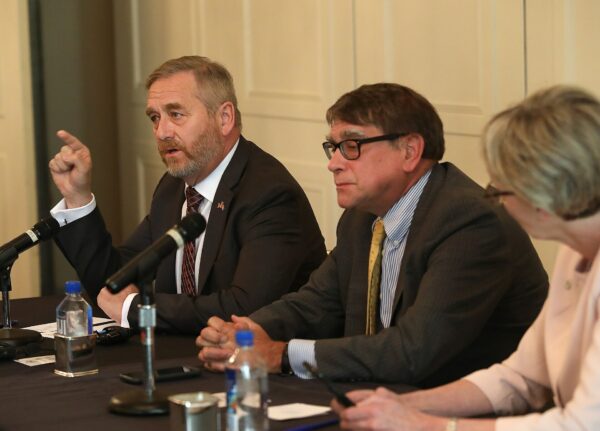
Ohio Attorney General Dave Yost is expected to resign from his post with eight months still remaining in his term, marking the latest development in a long political career shaped by shifting alliances and a rapidly evolving Republican landscape.
Yost, who is barred from seeking reelection due to term limits, had set his sights on the governor’s mansion in 2026. However, that effort struggled to gain traction after businessman Vivek Ramaswamy entered the race with backing from President Donald Trump and an early endorsement from the Ohio Republican Party. Ramaswamy ultimately secured a spot in the November general election following Tuesday’s primary, effectively sidelining Yost’s gubernatorial ambitions.
News of Yost’s expected resignation was first reported by The Columbus Dispatch, bringing renewed attention to a political résumé that spans more than two decades. His career began in 1999 as Delaware County auditor, followed by an appointment as county prosecutor in 2003. He later won election as Ohio state auditor in 2010, though not before making an earlier, unsuccessful bid for attorney general against current Governor Mike DeWine.
Yost eventually secured the attorney general’s office in 2018, becoming the state’s top law enforcement official. His tenure included involvement in several high-profile legal and political battles, reflecting both the priorities of the Republican Party and the broader national debates that have shaped recent years.
Following the Supreme Court’s 2022 decision overturning Roe v. Wade, Yost announced that Ohio’s “heartbeat bill” would take effect, restricting abortions as early as six weeks into pregnancy. The move placed Ohio firmly in the center of one of the country’s most contentious policy debates.
Yost also played a role in legal challenges tied to the 2020 presidential election. He filed a brief supporting Trump’s attempt to block certain ballots in Pennsylvania but later opposed a separate lawsuit brought by Texas Attorney General Ken Paxton that sought to prevent Joe Biden from being certified as president-elect. In a separate episode, Yost declined to grant provisional approval for Biden to appear as the Democratic nominee on Ohio’s 2024 ballot, a decision that was ultimately overturned by state lawmakers.
Beyond election-related disputes, Yost took a leading role in legal action following the East Palestine train derailment. His office filed a 58-count civil lawsuit against Norfolk Southern seeking to recover costs associated with cleanup efforts and environmental damage. He also pursued action against an individual and an organization known as the “Ohio Clean Water Fund,” alleging they had raised more than $141,000 under the guise of providing relief to affected residents. The case concluded with an order requiring more than $131,000 in donations to be repaid.
With Yost’s departure looming, Governor DeWine will be responsible for appointing an interim attorney general. The political reshuffling is already underway, with Auditor Keith Faber running for the position in November and Secretary of State Frank LaRose seeking Faber’s current role. Meanwhile, Treasurer Robert Sprague secured the GOP nomination for secretary of state, and Jay Edwards claimed the nomination for treasurer.
Yost’s resignation signals not just the end of a chapter for one of Ohio’s longtime public officials, but also a reminder of how quickly political fortunes can shift. As new figures rise and old alliances give way to fresh priorities, the landscape continues to evolve—often at a pace that leaves little room for those unable to keep up.