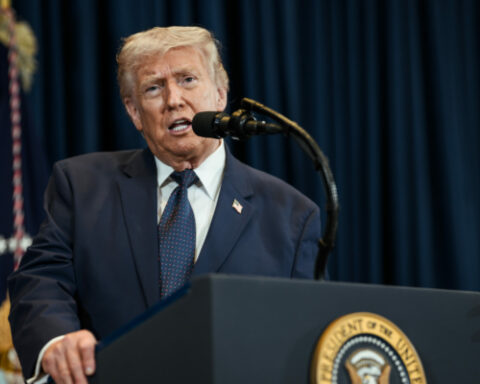


A federal judge on Friday ruled that President Donald Trump’s name must be removed from the Kennedy Center, concluding that the institution’s board exceeded its legal authority when it voted to add the president’s name to the landmark performing arts venue.
U.S. District Judge Christopher Cooper sided with Rep. Joyce Beatty, a Democrat from Ohio and member of the Kennedy Center’s Board of Trustees, who challenged both the renaming effort and a separate proposal to temporarily shut down the center for renovations. The lawsuit, filed last December, argued that Congress originally established the institution’s name through federal law and that any formal change would require congressional approval.
In a sweeping 94-page decision, Cooper agreed with that argument, writing that the Kennedy Center’s governing statute leaves little room for interpretation.
“The Kennedy Center’s organic statute makes crystal clear that the Center is to be named for President Kennedy, and it cannot bear any other formal name or public memorial based on the Board’s unilateral say-so,” Cooper wrote. “Congress gave the Kennedy Center its name, and only Congress can change it.”
The ruling represents a significant setback for the board’s effort to rebrand the institution. Last December, trustees voted to rename the venue “The Donald J. Trump and The John F. Kennedy Memorial Center for the Performing Arts.” According to the court record, the change was implemented on the venue’s website within hours, and work soon began to add Trump’s name to the building’s exterior.
Cooper sharply rejected the argument that the change amounted to little more than an informal nickname. In his ruling, he characterized that defense as unconvincing and argued that attaching Trump’s name to the center fundamentally altered the institution’s official identity.
“The ‘Trump Kennedy Center’ label adds an entirely new name to the Center’s formal title and relegates President Kennedy’s name to second place,” Cooper wrote. “If that is not a renaming, what is?”
The judge also dismissed comparisons to other naming practices cited by supporters of the change. He specifically referenced arguments involving the administration’s use of alternative labels for government institutions, saying those examples failed to address the central legal issue before the court.
According to Cooper, the Kennedy Center occupies a unique position because it serves as a memorial established by Congress to honor a specific public figure. As a result, he concluded that the board lacked authority to alter that designation on its own.
“In sum, the Board clearly violated the Kennedy Center’s organic statute—and the terms of the trust—when it formally renamed the Center after President Trump and memorialized him on the face of the building,” Cooper wrote. He further described the board’s justification as a “lackluster attempt” to portray the action as something less significant than a formal renaming.
The judge also addressed a separate controversy involving plans to close the Kennedy Center for two years following this summer’s July 4 celebrations. Beatty challenged that proposal as well, arguing that the approval process was flawed.
Cooper agreed that the board improperly stripped Beatty of her voting rights during a March meeting in which the closure plan was approved. As a result, he blocked the shutdown from moving forward for now.
At the same time, the judge acknowledged that the building requires substantial repair work and noted that renovations remain an important concern. While halting the current closure plan, he left open the possibility that the board could revisit the issue in the future after conducting a more comprehensive review and following proper procedures.
[READ MORE: Joe Rogan Questions White House UFC Event, Calls Planned Spectacle “Odd”]