
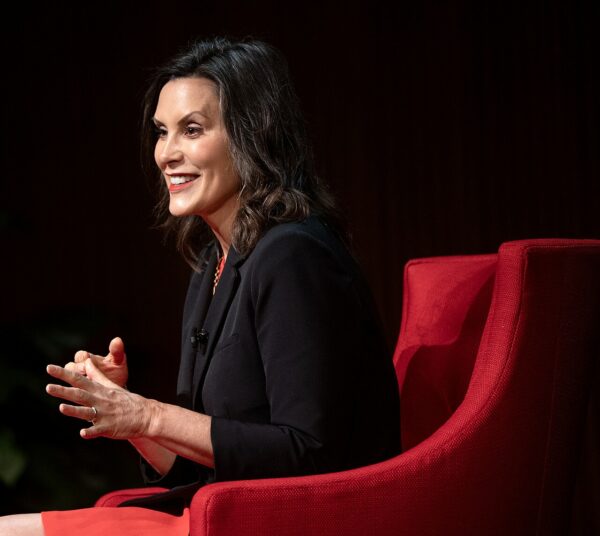
Michigan Gov. Gretchen Whitmer (D) made a surprise endorsement Friday in the closely watched Democratic primary for the state’s open U.S. Senate seat, throwing her support behind Rep. Haley Stevens (D-Mich.) just days before voters head to the polls on Aug. 4.
The late endorsement underscores growing concern among establishment Democrats over the possibility that progressive candidate Abdul El-Sayed could capture the party’s nomination in one of the nation’s most competitive Senate races.
In a video advertisement released through Stevens’ campaign, Whitmer praised the congresswoman’s record and said her endorsement was driven by a focus on delivering results for Michigan residents.
“As governor, I’ve had one strategy: Get things done. And that strategy informs everything that I do, and that’s why I’m endorsing Haley Stevens for the U.S. Senate,” Whitmer said.
“Just like me, Haley will do whatever it takes to get things done for the people of Michigan, and we need her now more than ever,” she added.
Stevens welcomed the endorsement, calling it a significant honor to receive the backing of the Michigan governor, who has also been mentioned as a potential Democratic presidential contender in 2028.
“Governor Whitmer embodies what it means to be ‘that woman from Michigan’ and everything that makes our state so special,” Stevens said in a statement. “She’s authentically Michigan — and I could not be more honored to have her endorsement for U.S. Senate. Let’s go win!”
Whitmer joins a relatively small group of prominent Democrats who have chosen to weigh in on the competitive primary to replace retiring Sen. Gary Peters (D-Mich.).
The endorsement comes as members of the Democratic establishment have expressed concern that an El-Sayed victory could make it more difficult for the party to retain the Senate seat in November’s general election.
Peters had previously indicated he would remain on the sidelines during the original three-way primary contest. However, after state Sen. Mallory McMorrow ended her Senate campaign, Peters endorsed Stevens earlier this month. Michigan Attorney General Dana Nessel (D) also backed Stevens.
El-Sayed, meanwhile, has secured support from some of the Democratic Party’s most prominent progressive figures.
Sen. Bernie Sanders (I-Vt.) and Rep. Alexandria Ocasio-Cortez (D-N.Y.) have both endorsed the former Wayne County health director and campaigned on his behalf during the final stretch of the primary. El-Sayed has also received the endorsement of the influential United Auto Workers union.
Some Republicans have suggested they would prefer to face El-Sayed in the general election.
CNN reported that Michigan Republican Senate nominee Mike Rogers told supporters during a private call last month that he believed he would be in “good shape” if El-Sayed emerged as the Democratic nominee.
Responding to the reported comments, El-Sayed campaign spokesperson Roxie Richner dismissed Rogers’ assessment.
“Mike Rogers won’t be in ‘good shape’ in November, but the people of Michigan will be,” Richner said in a statement to CNN.
Michigan Republicans also seized on Whitmer’s endorsement, arguing it reflected growing anxiety among Democratic leaders.
“Establishment Democrats are beyond panicked, and Gretchen Whitmer’s endorsement of Haley Stevens proves it,” Michigan Republican Party senior communications adviser Greg Manz said in a statement.
Manz added that Whitmer’s backing of Stevens “does not change the fact that she is every bit as extreme as Abdul El-Sayed.”
The Michigan contest comes as progressive candidates have found success in several Democratic House primaries this election cycle, with a number of democratic socialists defeating incumbent House Democrats in reliably blue districts.
El-Sayed’s campaign is now viewed as a test of whether that progressive momentum can extend beyond House races into a high-profile Senate contest in a battleground state.
The race has taken on added significance following the collapse of Graham Platner’s Senate bid in Maine earlier this month, leaving political observers watching closely to see whether Michigan progressives can translate recent primary victories into success in a statewide election.