

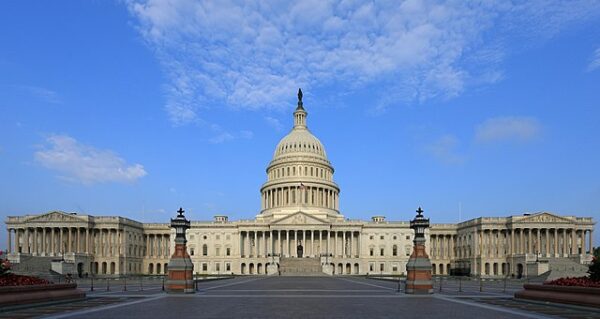
In a dramatic early-morning vote, a small group of senators reportedly moved to end a partial government shutdown just hours before lawmakers departed Washington for a two-week Easter recess, underscoring both the urgency of the moment and the deep divisions still gripping Capitol Hill.
At 2:18 a.m. Friday, five senators approved a funding measure aimed at reopening parts of the federal government that had been caught in a political standoff. The late-night agreement followed a contentious impasse in which Senate Democrats filibustered a Department of Homeland Security appropriations bill, pressing for new limits on Immigration and Customs Enforcement after two fatal January shootings in Minneapolis tied to clashes between federal agents and anti-enforcement agitators.
Republicans, led by Senate Majority Leader John Thune of South Dakota, resisted those demands. The final legislation notably excludes provisions sought by Democrats, including requirements that ICE agents stop wearing masks and obtain judicial warrants before entering private property to apprehend illegal immigrants. At the same time, the bill stops short of providing funding for ICE itself, leaving a key enforcement arm of the federal government in limbo. Portions of Customs and Border Protection also remain unfunded, highlighting the incomplete nature of the compromise.
The vote itself was narrowly attended. Thune and Sen. Eric Schmitt of Missouri joined Democratic Sens. Brian Schatz of Hawaii and Andy Kim of New Jersey, with Sen. Bernie Moreno of Ohio presiding, according to reports. The small turnout reflected both the unusual timing and the urgency to break a deadlock that had already begun to ripple beyond Washington.
Those consequences became increasingly visible earlier in the week, when airport disruptions mounted amid the shutdown. With Transportation Security Administration officers calling out sick or leaving their posts due to missed paychecks, long lines and travel delays spread across the country. In response, President Donald Trump ordered ICE agents to assist TSA operations at airports, an extraordinary move that underscored the cascading effects of Washington gridlock.
Roughly eight hours after that directive, Trump escalated further, instructing Homeland Security Secretary Markwayne Mullen to ensure TSA agents were paid despite the ongoing funding lapse. In a statement, the president blamed Democrats for creating what he described as a national crisis and said he was acting under his legal authority to stabilize the situation and restore order.
While the Senate’s early-morning action may temporarily ease the immediate strain, the broader conflict remains unresolved. The amended funding bill must still clear the House of Representatives, where its prospects are uncertain and where divisions over immigration enforcement are likely to resurface.
Meanwhile, the Senate failed to advance the SAVE America Act, legislation that would have imposed proof-of-citizenship requirements for voter registration, added voter ID rules, and sought to remove non-citizens from voter rolls.
The episode serves as another reminder of how quickly political brinkmanship in Washington can spill into real-world consequences for everyday Americans. Even as lawmakers head home for recess, the underlying disputes—particularly over immigration enforcement—remain unsettled, raising the prospect of renewed clashes ahead.
[READ MORE: Morning Joe Hosts Lock In Long-Term Deals as Media Influence Grows Ahead of Key Elections]