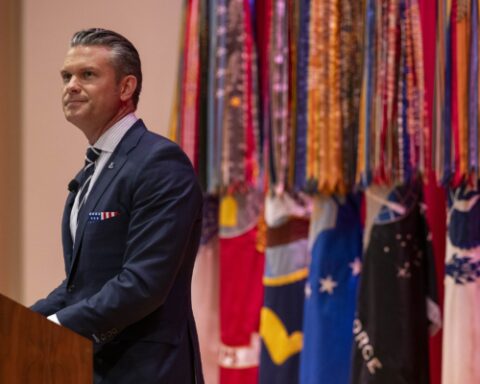

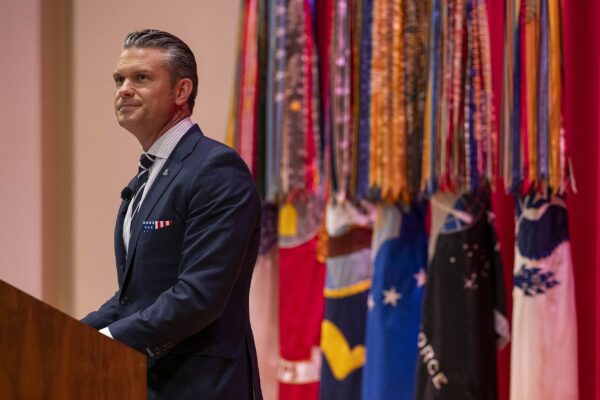
Defense Secretary Pete Hegseth on Tuesday rejected claims that a fresh exchange of fire between U.S. and Iranian forces had shattered the fragile ceasefire, instead characterizing the confrontation as a contained and “separate and distinct” matter tied to maritime security.
Speaking at a Pentagon briefing alongside Joint Chiefs Chairman Gen. Dan Caine, Hegseth faced pointed questions after tensions flared in the Strait of Hormuz just a day earlier. According to U.S. Central Command, Iranian forces responded to efforts by President Donald Trump to safeguard commercial shipping routes by launching cruise missiles at U.S. Navy vessels and deploying drones toward commercial ships operating in the region.
U.S. forces intercepted all incoming threats, officials said, and no American or U.S.-flagged vessels were struck. During the incident, U.S. military personnel also destroyed six Iranian small boats.
Despite the exchange, Hegseth made clear the administration does not view the incident as a breakdown of the broader ceasefire arrangement.
“No, the ceasefire is not over,” he said directly when asked whether the back-and-forth signaled a return to open hostilities.
Instead, the defense secretary framed the clash as part of a narrower effort focused on protecting key waterways. “Ultimately, this is a separate and distinct project,” Hegseth explained, adding that some degree of friction had been anticipated in the early stages of the ceasefire.
He noted that U.S. forces had acted decisively in response to Iranian actions, emphasizing that Washington had been clear about its willingness to defend its assets. “We said we would defend and defend aggressively, and we absolutely have. Iran knows that,” he said.
Hegseth also stressed that the ultimate determination of whether any incident rises to the level of a ceasefire violation rests with the president. At the same time, he urged restraint from Tehran, warning that further provocations could risk pushing the situation beyond the current threshold.
“We would urge Iran to be prudent in the actions that they take, to keep that underneath this threshold,” he said.
The defense secretary underscored that the U.S. mission in the region remains centered on maintaining freedom of navigation through one of the world’s most strategically important waterways. The Strait of Hormuz serves as a critical artery for global commerce, and disruptions there can have far-reaching consequences.
“This is about the [strait], this is about freedom of navigation, and about international waterways,” Hegseth said. “This is about free flow of commerce.”
He added that, in the administration’s view, Iran is the only party currently challenging those principles.
While officials insist the ceasefire remains intact for now, the episode highlights the delicate balance between maintaining deterrence and avoiding a broader escalation. Even limited confrontations carry the risk of spiraling, particularly in a region where tensions can shift rapidly.
For the moment, the administration is projecting confidence that the situation remains under control. But as Hegseth acknowledged, the U.S. will be “watching very, very closely,” a sign that even so-called “separate” operations can quickly test the durability of peace—especially when the margin for error is razor thin.