

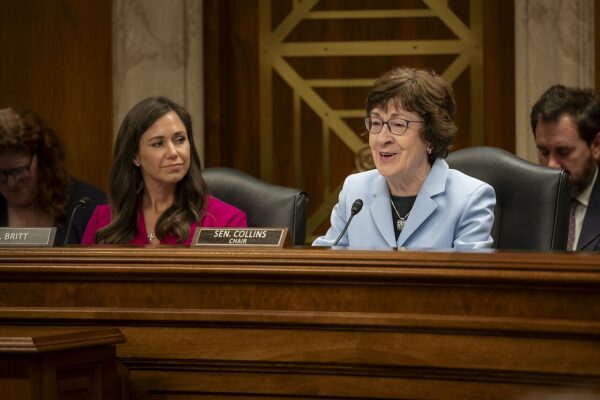
Former Maine Senate President Troy Jackson has edged ahead of incumbent Sen. Susan Collins, R-Maine, in a new poll measuring a hypothetical U.S. Senate matchup, as Democrats look to regroup after their original nominee exited the race.
According to a University of New Hampshire survey, 49% of likely general election voters in Maine said they would support Jackson if the election were held today, while 46% said they would back Collins. Another 2% selected another candidate, and 3% remained undecided.
Jackson has quickly become the Democratic Party’s leading candidate to challenge Collins after Graham Platner, who won last month’s Democratic primary, withdrew from the race following allegations of sexual misconduct.
Jackson, who unsuccessfully sought the governorship this election cycle, now appears positioned to officially secure the Democratic nomination during the party’s expedited convention in Bangor this weekend. His path to the nomination became significantly clearer after his remaining top competitors dropped out of the contest, allowing him to secure an overwhelming majority of delegates.
The University of New Hampshire poll also examined support among Democratic primary voters. Jackson dominated that field with 51% support, well ahead of former Maine Center for Disease Control and Prevention Director Nirav Shah, who received 26%, and Maine Secretary of State Shenna Bellows, who earned 11%.
All remaining Democratic contenders registered 1% support or less in the survey. Both Shah and Bellows have since ended their campaigns, further solidifying Jackson’s position as the party’s expected nominee.
Jackson’s emergence follows a dramatic shakeup in the Democratic race.
Platner stepped aside only weeks after winning the Democratic primary by a wide margin. His campaign unraveled after Politico reported that a woman accused him of raping her in 2021. Separately, another woman who had dated Platner on and off alleged to The Washington Post that he removed condoms without her consent during sexual encounters.
Platner has strongly denied both allegations.
Despite his denials, support for his campaign declined following the reports, ultimately leading to his withdrawal from the Senate race.
The contest for Collins’s seat is expected to be one of the most closely watched Senate races of the election cycle. Democrats view the race as a critical opportunity in their effort to gain the four additional Senate seats needed to take control of the chamber this fall.
Decision Desk HQ currently classifies the Maine race as one of only three Senate contests considered a “toss up.” According to its forecast, Republicans currently have a 53% chance of retaining the seat.
With Jackson now expected to become the Democratic nominee, party leaders are hoping a new candidate can rebuild momentum following Platner’s exit and mount a competitive challenge against Collins in the general election.
The University of New Hampshire conducted the survey between July 15 and July 20. The poll included 1,236 Maine residents overall. Among the sample of 1,178 likely general election voters, the margin of sampling error was plus or minus 2.9 percentage points. For the survey of 538 Democratic primary voters, the margin of error was plus or minus 4.3 percentage points.