
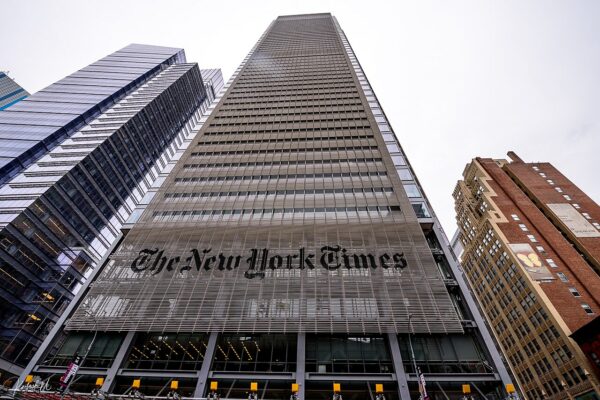
The Trump administration is pursuing the phone records of several New York Times journalists, along with records connected to two of their spouses, as part of an effort to identify confidential sources who provided information for reporting about security concerns involving the Qatari-gifted Air Force One aircraft.
According to The New York Times, the Justice Department moved quickly after the newspaper published a report earlier this month detailing security deficiencies on the aircraft.
The Times reported that the aircraft, which President Donald Trump flew to Turkey, “lacks the same defensive countermeasures as the older model, including antimissile capabilities.”
Just one day after that story was published, the Justice Department hand-delivered subpoenas ordering the reporters to testify before a federal grand jury.
Times reporter Michael M. Grynbaum described the administration’s actions in a report published Monday, characterizing the effort as an unusually aggressive attempt to identify confidential sources.
“The government’s actions amount to an extraordinarily aggressive and unorthodox attempt by the Trump administration to unearth the confidential sources of independent journalists whose reporting had angered the president,” Grynbaum wrote.
According to Grynbaum, the investigation did not stop with the reporters themselves.
He reported that additional subpoenas sought information involving calls and text messages connected to the phones of two reporters’ spouses. Those requests were detailed in a motion filed Saturday by attorneys representing The New York Times, who are asking the court to block the subpoenas.
“The additional subpoenas — which also sought information about calls and messages on the phones of two of the reporters’ spouses — were described in a motion filed on Saturday by lawyers for The Times, which is seeking to quash the requests,” Grynbaum wrote.
The legal filing became public Monday morning after U.S. District Judge Arun Subramanian in Manhattan unsealed the motion.
The dispute stems from reporting about the Qatari-gifted aircraft that is intended to serve as Air Force One. The Times reported that the plane lacks some of the defensive capabilities found on the older presidential aircraft, specifically noting the absence of antimissile systems.
President Trump appeared to acknowledge that additional work on the aircraft is planned during remarks Sunday at Joint Base Andrews.
When asked why he was flying aboard an aircraft that reportedly lacks the antimissile defense systems typically used to protect the president, Trump said the plane already possesses significant capabilities but would soon undergo additional upgrades.
“It has a lot of capability, but as I understand it, in about a month or so, they’re going to send it to have it be maxed out,” Trump said.
In a separate report published Monday, Times reporter Maggie Haberman wrote that it remained unclear exactly what upgrades the president was referencing or whether the timeline he provided was realistic.
“It was not clear what specific upgrades Mr. Trump was referring to, or whether the time frame he gave of a month until it is ready was realistic,” Haberman wrote.
She added that the president’s remarks appeared to acknowledge that the aircraft’s security features are not as extensive as those found on Air Force One models that were designed from the outset to serve as the president’s aircraft.
“Nonetheless, it appeared to be an admission from the president that the plane’s security measures are not as extensive as the models that have been designed to be built from the ground up to serve as Air Force One,” Haberman wrote.
The subpoenas and legal battle now place the Justice Department and The New York Times at odds over the administration’s effort to identify the confidential sources behind the reporting on the aircraft’s security capabilities.