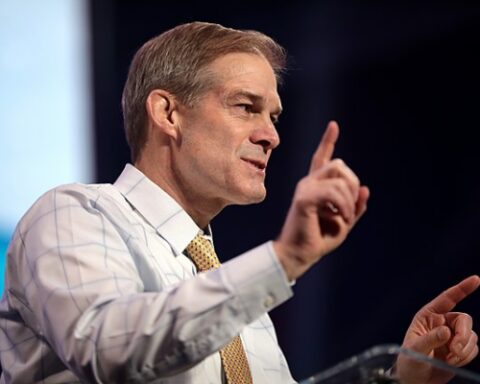

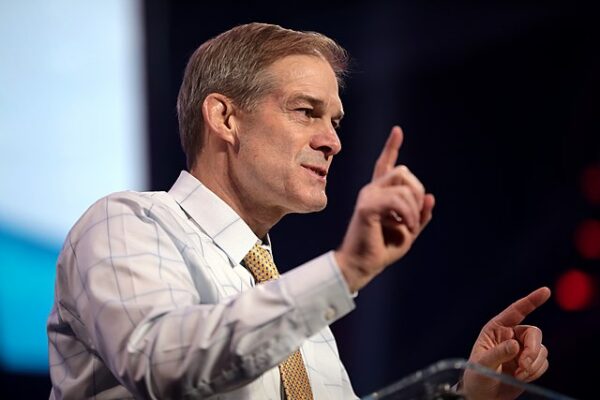
Rep. Jim Jordan on Monday raised concerns that the United States may be entering a period where it is no longer prudent to gather the nation’s top leadership in a single location, following a violent incident at the White House Correspondents’ Association dinner over the weekend.
Appearing on NewsNation’s “On Balance,” Jordan responded to questions about whether it remains wise to have the president, vice president, and speaker of the House—first, second, and third in the line of presidential succession—together in one ballroom alongside much of the Cabinet. His answer reflected unease, though not certainty.
“Yeah, we may be. I hope not. You hate for it to come to that,” Jordan said, adding that security professionals would ultimately need to weigh in on whether such gatherings should continue in their current form.
The remarks come after a shooting at the annual dinner, an event traditionally seen as a symbol of the intersection between government and the press. The incident has prompted renewed scrutiny over how such high-profile gatherings are secured, particularly when so many key officials are present in one place.
White House press secretary Karoline Leavitt pointed to what she described as a broader climate of political hostility, arguing that rhetoric from prominent Democrats contributed to the attack. Speaking to reporters, Leavitt said the violence was rooted in what she called a “systemic demonization” of Donald Trump and his supporters.
“This hateful and constant and violent rhetoric directed at President Trump day after day after day for 11 years has helped to legitimize this violence,” she said, characterizing the moment as a troubling escalation.
Meanwhile, House Speaker Mike Johnson voiced separate concerns about the physical security measures in place at the event. In an interview on Fox News’s “America’s Newsroom,” Johnson described the setup as appearing “a little lax,” at least from his vantage point.
While noting that many officials entered through secured access points with their own protective details, Johnson suggested that broader screening measures for attendees may not have been sufficient. “It doesn’t sound like it was sufficient,” he said, referencing reports about how individuals were able to enter the venue.
The convergence of these concerns—about both rhetoric and security logistics—has fueled a wider conversation in Washington about how to protect public officials without fundamentally altering long-standing traditions. Events like the correspondents’ dinner have historically served as rare moments where political leaders, journalists, and officials gather in a shared space, even amid deep disagreements.
Now, however, the calculus may be changing. The idea that the country’s top leadership could be at heightened risk simply by appearing together raises difficult questions about how to balance openness with safety.
At the same time, the discussion reflects a broader tension that extends beyond any single event. As security concerns grow, so too does the impulse to harden environments and limit exposure—steps that may be necessary, but that also signal a shift in how public life is conducted.
For now, lawmakers appear divided on what changes, if any, should be made. Jordan acknowledged the gravity of the moment while expressing hope that such precautions would not become permanent. Still, the events of the weekend have left an impression that may be hard to shake, as officials grapple with the reality that even long-standing institutions are not immune from the pressures of an increasingly uncertain security landscape.
[READ MORE: Trump Faces Tough Questions After WHCA Shooting, Defends Security Response While Reflecting on Repeated Threats]