

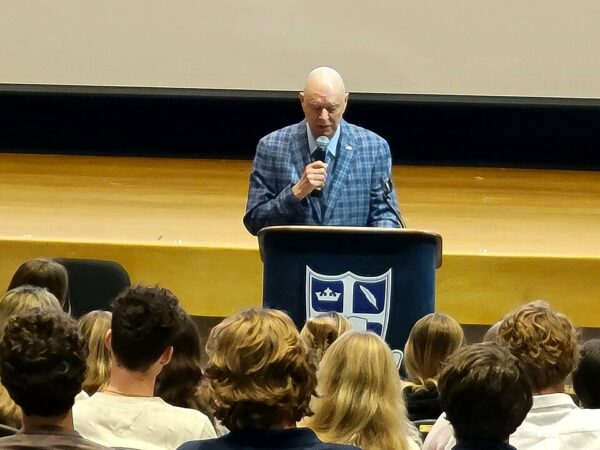
Former Florida Congressman Bill Posey passed away Sunday at the age of 78, closing the chapter on a lengthy career in public service that spanned decades at both the state and federal level. Posey died at Holmes Regional Medical Center in Melbourne, surrounded by his wife and two daughters. His cause of death was not disclosed.
Posey’s tenure in Washington began in 2009, when he won election to represent Florida’s 15th Congressional District. Over time, he would also represent the state’s 8th District, serving until 2025. His entry into Congress followed years of work building connections within his community, including time spent on a city council as well as in the Florida House of Representatives and the Florida Senate.
In a statement shared on X, Florida Rep. Mike Haridopolos described Posey as a “principled conservative” known for his commitment to fiscal responsibility and government transparency. Those themes defined much of Posey’s time in office, where he built a reputation as a reliable voice for limited government and accountability—priorities that continue to resonate with many voters concerned about federal overreach.
Posey was no stranger to the nation’s capital, having been born in Washington, D.C. During his years in Congress, he served on the House Committee on Financial Services as well as the Committee on Science, Space, and Technology. His work on these committees reflected both his policy interests and his roots in Florida’s Space Coast, where economic vitality is closely tied to the aerospace industry.
Beyond committee assignments, Posey aligned himself with several influential conservative groups, including the House Freedom Caucus and the Liberty Caucus. In a tribute, the House Freedom Caucus praised his “unwavering integrity” and commitment to liberty, noting that his leadership left a lasting imprint on both the caucus and the broader conservative movement.
Before entering politics, Posey worked in the aerospace sector, including time with McDonnell Douglas and involvement in Apollo-era efforts at Kennedy Space Center. He later founded his own real estate company, bringing private-sector experience into his public career—an approach often valued by constituents who favor lawmakers with firsthand knowledge of business and industry.
Though much of Posey’s career focused on domestic policy and economic stewardship, his long service also unfolded during periods when Washington grappled with broader national priorities, including debates that extended beyond America’s borders. For many lawmakers of his generation, navigating those challenges required balancing local concerns with decisions that carried far-reaching consequences, a responsibility that often defines the weight of public office.
House Speaker Mike Johnson offered a personal reflection, calling Posey a “genuinely good man and a faithful friend.” Johnson added that he and his wife were praying for Posey’s family, including his wife Katie, described as his high school sweetheart.
Posey’s educational background included an Associate of Arts degree from Eastern Florida State College, according to his congressional biography. While not the most traditional path to national office, his career demonstrated how local engagement and persistence can carry a public servant to the highest levels of government.
As tributes continue to pour in, Posey is being remembered not only for his policy positions, but for a steady presence in a political environment often marked by sharp divisions. His passing marks the loss of a figure who spent years advocating for conservative principles while representing a region deeply connected to America’s technological and economic ambitions.